I hate to break it to you, but if your website barely has any words on it, no amount of beautiful design is going to help you rank on Google or convert website visitors into clients ¯\_(ツ)_/¯
I see this all the time with small business websites. Stunning branding, gorgeous photos, and then… one single sentence on the home page. Or a full-screen slideshow with zero context about what the business actually does. Interior designers and photographers, the photos of your work are amazing! But it’s not enough to rank higher or convert clients.
I get it — minimal looks clean. And if you’re a visual business, you want to show off your work. But when it comes to your website, minimal copy is actually working against you. So keep reading to see why you really need website copy!

Search engines and AI tools rely on your words
Here’s the thing, Google and AI platforms (like ChatGPT or Gemini) have in common: they can’t see your photos. And even if they can see your photos, they won’t understand the context behind them. They can’t guess what your business does based on your branding.
They rely entirely on text to understand who you are, what you offer, who you serve, and when your site should show up in search results.
If your website doesn’t clearly explain what services you offer, who those services are for, where you’re located or who you work with, and what makes you different from your competitors — search engines and AI platforms don’t have much to work with.
If Google doesn’t know what you do, how will they know what to rank you for?
Having minimal copy and unclear keywords makes it harder for your site to rank on Google, and much less likely for AI tools to recommend you when someone is searching for your services!
Your copy is the foundation of both SEO and AI search visibility. Without it, you’re asking search engines to try to connect the dots, but they’re not smart enough to do that yet.
You need copy to convert clients
Have you ever visited a website and been more confused about what the business does than before you looked at it?
Yeah you want to avoid that on your website, too!
Clarity is what converts clients.
And your website copy is doing a very important job for the actual humans landing on your site. When someone finds you, they’re quickly trying to figure out:
- Am I in the right place?
- Does this business understand my problem?
- Do they work with people like me?
- Do I trust them enough to reach out?
If your copy doesn’t answer those questions quickly and clearly, if your website copy is vague or fluffy, or if you just don’t even have much website copy, people are less likely to want to hire you. They won’t stick around to find out more, and they’ll click back to Google and check out the next option.

Or they might reach out with a bunch of questions that could be easily answered on your website. Or you could get a lot of leads that aren’t a good fit because your website isn’t doing the work of connecting with people who are the right fit.
So clear, strategic copy filters in the right clients (and turns away the wrong ones!) before they even go to your Contact page.
Minimalism ≠ clarity
There’s a misconception floating around that less copy means a better user experience. But clarity converts better than minimalism every time.
A home page that says “Helping businesses grow online” doesn’t tell anyone what you actually do, how you do it, or why they should hire you over someone else.
Here’s a quick exercise: search Google for your services right now, or ask ChatGPT or Gemini to recommend someone in your industry. Then look at the websites that show up at the top.
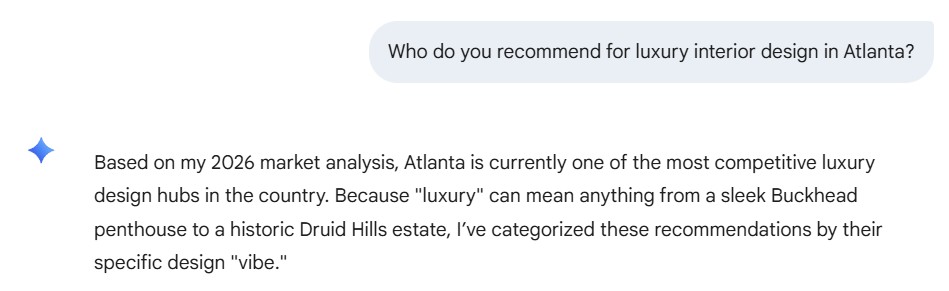
They almost always have clear headlines that explain exactly what they do, supporting copy that speaks to their ideal client, detailed service pages that walk people through the process, and content that builds trust through education and expertise.
It’s rarely minimal. It’s intentional.
“But My Clients Don’t Like to Read”
Probably the #1 pushback I get from clients about adding more website copy to their site is that their ideal clients don’t like to read a lot of information.
First of all, that’s a huge generalization and I don’t think every single one of their clients falls into that bucket. But yes, there are definitely people who make quick decisions and don’t want to read a lot!
And there are ways to add more website copy that is still informative and long enough to help your SEO and AI search strategies while being strategic for the people who just want to make a quick decision or skim. All you have to do is make sure you add the most important information towards the top of the page.
Don’t make people have to scroll to find out what you do or where you’re located. Make sure you address the main points in the first sections of a page (which incidentally, will help your SEO and AI search strategies anyway). And be sure to add some eye-catching calls-to-action throughout your page to lead people to where they should go next. That way when they reach the point where they’re ready to contact you, they have a button that leads them right to that page instead of having to scroll back up to your menu.

Make sure your calls-to-action on your pages stand out! Buttons > hyperlinked text
For people who like to skim, add clear, eye-catching headings for each section. That way they can scroll to the sections that they’re most interested in. And make sure you’re doing common sense things for user experience like not having huge sections of text or giant photos or videos that take forever to load.
So don’t be scared that adding copy will turn people away because you want to make sure you’re being strategic for both the quick decision makers and the researchers (aka me). Especially since the researchers are likely comparing your website with your competitors and making their decision based on all the information they’re seeing from everyone.
You don’t need more words — you need the right ones
Well-written website copy doesn’t just help you rank — it supports everything else you’re doing to grow your business. It helps Google understand what topics and keywords your site should rank for, makes it easier for AI tools to understand and recommend your business, keeps visitors on your site longer (which is a signal Google pays attention to!), and builds trust for your potential clients.
This is why copywriting and SEO need to work together, not separately.
You don’t need keyword-stuffed paragraphs or a hard sales pitch. You need copy that’s clear, helpful, and written with both search engines and real humans in mind to make sure your website clearly communicates what you do, who you help, how you help them, and why you’re the right choice.
If your site isn’t doing that right now, it may be time to revisit your copy, both for rankings AND for sustainable business growth.
And if you want help writing copy that supports your SEO, AI search visibility, and client conversions, that’s exactly what I offer with my Custom SEO Services! Because getting found is important, but turning that visibility into clients is what actually grows your business. Get in touch if you’re ready to rank higher AND convert more visitors to clients with your website copy.