Want to get your business recommended by ChatGPT and Claude? You’re not alone!
A lot of my clients come to me because they want to rank on Google. But more and more of them are coming to me because they want to get recommended by AI, too.
Because people are using AI platforms like ChatGPT, Claude, and Perplexity to find businesses to hire (I’m doing it, too!). Instead of typing “interior designer Philadelphia” into Google and scrolling through all the results and visiting all the websites to find the right fit, people are going to ChatGPT and searching for exactly what they want. Something like “I’m looking for a female interior designer in Philadelphia who creates luxury designs that are still family friendly.” And they want AI to hand them a name.
But the question is: is that name yours?
If you want to get recommended by AI platforms, you need something that most small business owners are completely overlooking. You need brand authority.
Want the full guide on brand authority? I wrote an entire book on it!

What brand authority actually means
Soooo what is brand authority? And what does it have to do with getting your business recommended by ChatGPT?
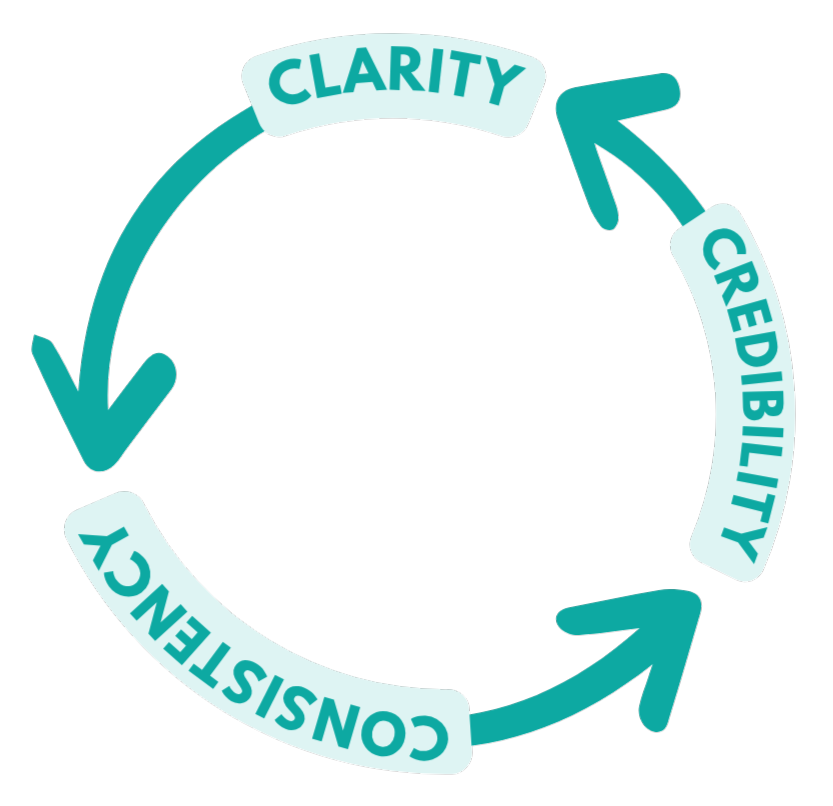
Brand authority isn’t about having the most followers or the biggest email list. It is not about going viral or getting featured in Forbes (but if Forbes calls, obviously pick up!). Brand authority comes down to three things: clarity, consistency, and credibility.
When your brand is clear, people know exactly what you do and who you help. When it is consistent, they see the same message everywhere they find you. When it is credible, there is real proof that you are as good as you say you are.
And those three things alllll work together to tell both humans and AI platforms that your business is actually worth recommending. The businesses that are showing up in AI recommendations right now are the ones that have been building all three. They’re not wasting their time on vanity metrics or trying to get more Instagram followers than their competitors!
How does AI decide who to recommend?
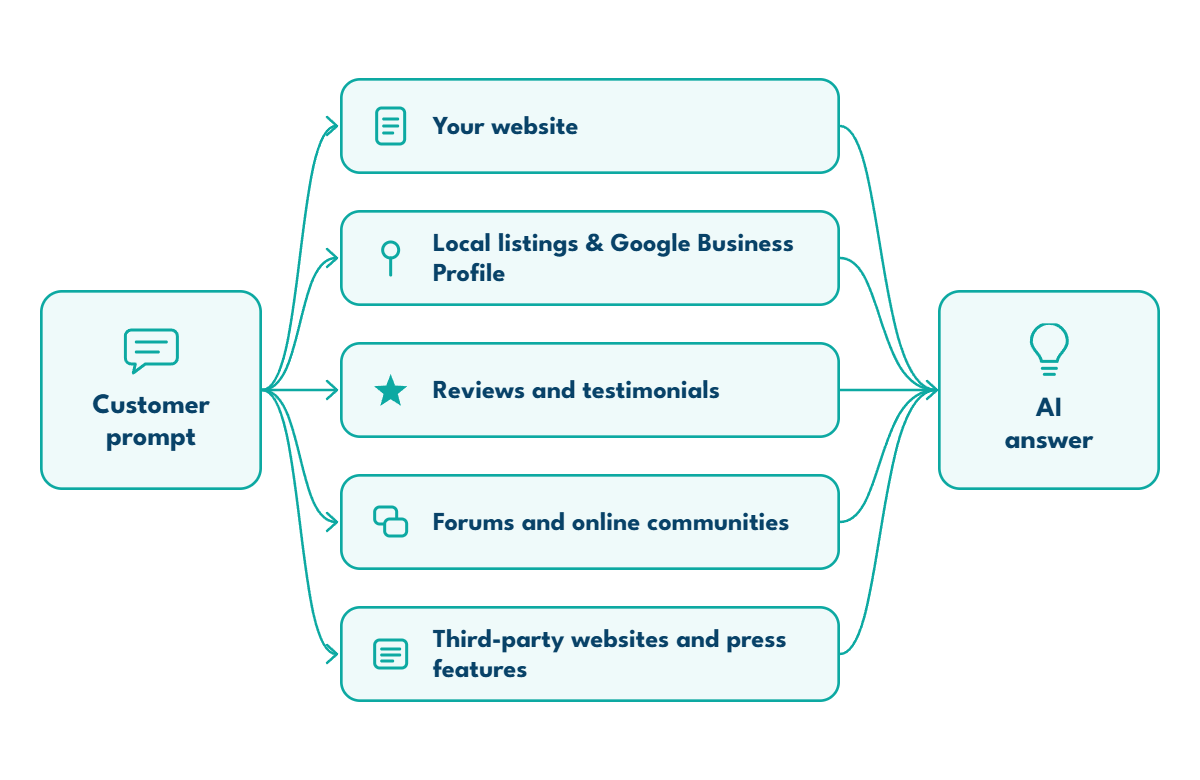
AI platforms don’t just read your website. They scan across the entire internet to find every place your business is mentioned, referenced, or cited.
We’re not going to get too technical here, but stay with me for just a second. How AI scans across the internet is called “query fan out.” So picture a hand fan. Your original search query is the base of the fan, and as the AI processes the question, it fans out into dozens of related searches all at once, looking for the most credible, clear, and consistent answer it can find.
So let’s say someone searches for “brand designer who works with new luxury brands.” That search query is the base of the “fan.” Then AI will search not just brand designer websites, but also press features, podcast interviews, directory listings, review platforms, blog posts, and literally anywhere else a brand designer has been talked about or cited online. They’re also separately searching queries like “brand designer for new businesses” and “best brand designer” and “luxury brand design” to see who shows up in all those searches and where the overlap is.
The businesses that AI platforms recommend are the ones have a presence in multiple places online, with a consistent and clear message, backed up by other people and platforms saying they are good at what they do. You basically need other businesses and websites to “endorse” your expertise since you can’t do it yourself.
The good news is that you don’t need a huge following or a huge marketing budget to build that kind of authority! You just need to be strategic in a few places.
Start with your brand message
AI can’t recommend a confusing brand. And honestly, neither can the humans who know you.
If your brand message is different on your website than it is on your Instagram, AI platforms get confused about who you are and what you do. If you talk about coaching on your website but your latest podcast interview was about copywriting, search platforms won’t know what to do with you. Everything needs to match!
This is the consistency piece of brand authority, and it is one of the most important things you can do for your AI visibility. Use the same language to describe your services every single place your brand shows up. Make sure your business name is spelled the same way across every platform. Talk about the same core topics so that both search platforms and potential clients associate your name with a specific area of expertise.
The clearer and more consistent your brand message is across the entire internet, the easier it is for AI platforms to know who you are and confidently recommend you when someone asks.

Don’t neglect your own website
Even though AI platforms are looking on other websites to back up your credibility, your website is still the foundation of your brand authority! Everything single thing you do online leads back to it, and AI platforms put a lot of weight on what your website copy actually says.
The most common problem I see with small business websites is that there isn’t nearly enough website copy. I work with a lot of creative businesses like interior designers and photographers who mostly rely on photos of their amazing work to sell their services. But Google and AI can’t understand the context and quality of images. And it might sound a bit harsh, but your photos aren’t answering all the questions your potential clients might have in order to hire you. ¯\_(ツ)_/¯
Or I’ll also see that business owners want to sound elevated or creative, so they end up with copy that sounds beautiful but says absolutely nothing. If I don’t know if “I’ll tell your story” means you’re a ghost writer for authors or someone who writes dating profiles, I’m not staying on your website for long trying to figure it out. If I don’t know what you mean, AI definitely doesn’t know what you mean.
AI can’t recommend a business it doesn’t understand. And neither can a potential client.
Your Home page needs to communicate what you do, who you help, and what makes you different before anyone has to scroll. At a minimum, your Service pages need to answer the three questions every potential client has before reaching out: what is this service, is it for me, and how can I sign up? And every page needs to use the actual words your ideal clients are actually searching for! Not industry jargon or poetic language that sounds great but never gets searched. I’m sorry, but no one is searching for a “storyteller.” They’re searching for a “copywriter.”
You can definitely have fun with your website copy and show your personality, but only after you’re super clear about what you do!

Once you know what keywords your clients are searching for, you need to actually use them throughout your website. One of my clients wanted to rank for terms related to “profitable coffee shops,” but she had never actually used that phrase anywhere on her website. Once she actually added it naturally throughout her copy, she started ranking on Google and getting more traffic from AI!
To sum it all up, if you want to be found for something, you have to say it clearly AND say it more than once.
Need help with figuring out keywords to use? I have a whole guide on keywords for you!
Use your blog posts to show off your expertise
Nope, blogging is not dead! Yes, people still read blog posts (not to sound meta, but you’re reading this blog post!). And maybe the more important thing to focus on for this topic is that Google and AI platforms read blog posts.
Blog posts are one of the most helpful strategies for getting recommended by AI, and a lot of small business owners are either not blogging at all or blogging about the wrong things.
AI platforms look for content that directly answers questions and shows that you’re a credible source. When someone asks an AI tool a question and your blog post gives a clear, specific, well-written answer to that exact question, you have a real shot at getting cited.
The main thing to focus on is to write about topics that are actually relevant to your services and your ideal clients. Not about your favorite restaurants or your weekend plans, but about the real questions your clients are asking before they hire someone like you. If you’re an accountant, a potential client might be searching for “when should a small business hire an accountant?” before they’re actually ready to hire you. So think about what people search for in the early stages of looking for your services and write about that so you can show both potential clients and AI platforms that you’re an expert.
A wedding photographer I worked with wrote a detailed guide about planning a wedding at a specific venue she had a lot of experience working at. A couple of months later, she emailed me to say she had gotten a client who found her by Googling that exact venue! She now ranks really well for keywords related to that venue and gets traffic from AI when people are searching for venues in the area she lives. That is what strategic blogging actually looks like!
So write about your experience and expertise. Use specific examples from your work. Share your genuine perspective. AI platforms are definitely looking for content that demonstrates real experience and expertise, and the more your blog posts show your actual knowledge and personality, the more likely they are to get cited.
Want the full guide on brand authority? I wrote an entire book on it!
Build trust signals that back you up
Trust is becoming more and more important since people can use AI to make them sound like an expert. So you not only have to say that you’re an expert in your industry, you need to show it, too.
AI is looking for trust signals both on and off of your website, like Google reviews, testimonials that speak to specific results, case studies that walk through real client outcomes, press features, directory listings, credentials and certifications, the number of years you have been in business, and the number of clients you have worked with.
Each of those signals builds up the credibility to your brand. And they don’t expire! A case study you wrote two years ago is still building trust with potential clients who find it today. A podcast interview you did eighteen months ago is still introducing you to new listeners who then go look up your website.
Trust signals keep working in the background waaaay after you get them.
So are you asking for these trust signals consistently? Are you asking happy clients to write you a review or pitching yourself to podcasts you’re ideal audience listens to? (I’ll be the first to admit that I need to work more on getting reviews) You just need to work on asking for the social proof, and then make sure it is visible on your website where both humans and AI can find it.

Get your name mentioned off your website
AI search is basically a combination of SEO and digital PR, so you need to work on your website just as much as off of it!
Remember query fan out? AI isn’t just looking at your website, it’s looking everywhere your business appears online.
This is where digital PR becomes incredibly important for AI visibility. Every time a credible website mentions your name, links to your website, or cites you as an expert, it’s basically endorsing your business and telling Google and AI platforms you are a legit authority in your industry.
This doesn’t have to mean getting featured in huge publications. Especially if it’s a huge publication that your ideal clients don’t even read! Because you want to make sure all the digital PR work you’re doing is helpful for both AI and getting in front of new clients. So this can look like being a guest on a podcast your ideal clients listen to, getting quoted in a roundup article in your niche, being listed in relevant industry directories, writing a guest blog post for a complementary business, or speaking at a virtual summit or a local event.
Every time someone else’s platform puts your name and expertise in front of their audience, it backs up your credibility and the more confident AI platforms are about recommending you.

Let’s wrap it all up
So as simply put as possible, if you want AI platforms to recommend your business, you need to give them something to work with.
Clear website copy that says exactly what you do and who you help. Blog posts that answer the real questions your ideal clients are asking. Trust signals that prove your expertise is real. Features and mentions on other platforms that expand your reach beyond your own website. And a brand message that is consistent enough that anyone who finds your website or hears you on a podcast immediately knows what you stand for and what to recommend you for.
The more you focus on consistency, clarity, and credibility, the stronger your brand authority will be! And that’s how you can get recommended by AI platforms more often.